
It’s Tuesday afternoon. Three separate clients have asked about Google Ads management in the last three weeks.
You quote the first one a higher rate to buy time, refer the second to a friendly freelancer, and tell the third, “We’re actually expanding our paid media team right now… let me get back to you with a proposal.”
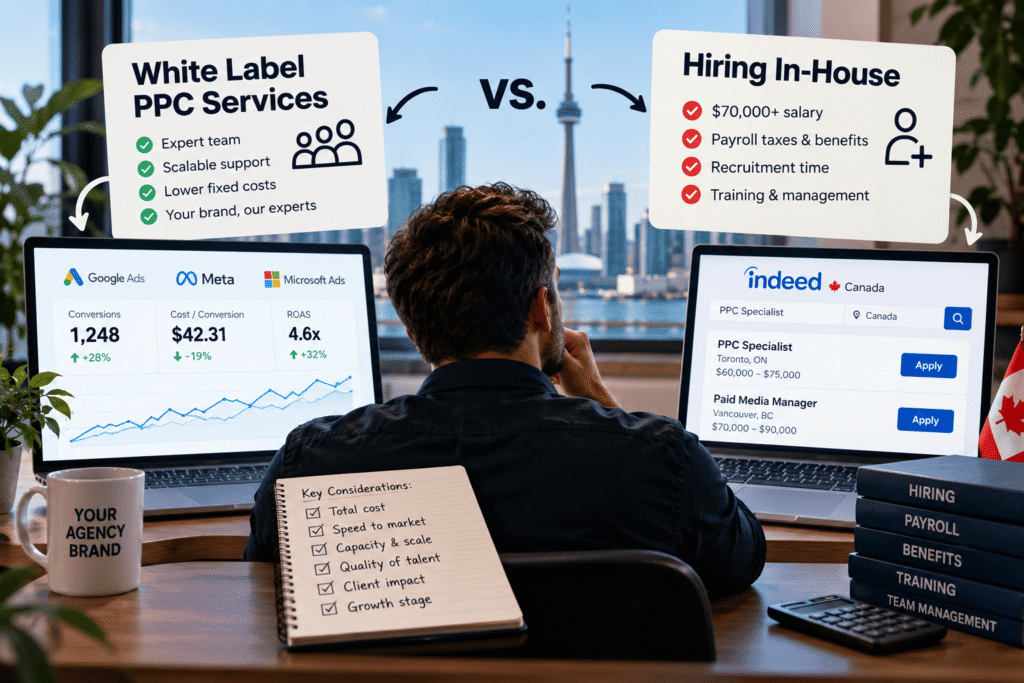
Then you open two tabs side by side on your desktop: Indeed Canada and a white-label PPC provider. You stare at both, weighing a $70,000 full-time salary against a monthly service retainer.
If you run a 5-to-25-person digital agency, SEO shop, or web design studio in Canada, you have probably experienced this.
Deciding how to fulfill paid ad management is one of the highest-stakes choices you will make this year. Get it right, and you add high-margin recurring revenue while deepening client retention. Get it wrong, and you burn through cash, overload your team, or destroy client relationships with poorly optimized campaigns.
This guide provides you with a decision framework built on real Canadian numbers. We will compare salary expectations, statutory payroll burdens (CPP, EI, provincial levies), currency exposures, and operational risks.
The goal isn’t to tell you that white label is always better, because it’s not in every case. The goal is to give you the financial and operational benchmarks to pick the right path for your agency at your current growth stage. Let’s get into it.

Two Models, One Goal
Before running the numbers, let’s establish a clear baseline. Both models (white label ppc services vs. an in-house team) exist to solve the same problem: delivering scalable, high-ROI paid ad management across Google Ads, Meta, Microsoft Ads, and vertical networks.
- White Label PPC: An external, specialized media-buying team manages your client accounts under your agency’s brand. Your logo is on every client report. The provider stays completely invisible. Your agency owns the client relationship, account access, and pricing markup; the white label team executes campaign setup, optimization, conversion tracking, and technical strategy.
- Hiring In-House: You recruit a PPC Specialist or Paid Media Manager as a direct employee (T4) on payroll. They work directly inside your communication channels (Slack, Teams), take full ownership of campaign management, and may join client calls as a direct representative of your firm.
Both models can drive impressive client outcomes. But both can fail if mismanaged.
The difference boils down to cost structure (variable vs. fixed), liability, and where your agency sits on its growth curve.
What It Actually Costs to Hire a PPC Specialist in Canada
When Canadian agency owners calculate the cost of a new hire, they almost always start and stop with the base salary figure listed on job postings. That calculation leaves out substantial compulsory overhead.
To understand the real financial commitment of an in-house hire, you must analyze the fully loaded cost of employment in Canada.
1. Base Salary Ranges Across Canada (2026 Data)
Media-buying compensation varies widely depending on experience and location. Verified compensation data across Canadian markets reflects the following base salary bands:
- Entry-Level PPC Specialist (1–3 years experience): $49,000 – $58,000 CAD
- Mid-Level PPC Specialist (3–6 years experience): $58,000 – $70,000 CAD
- Senior PPC Manager / Head of Paid Media (6+ years experience): $70,000 – $90,000+ CAD
Market Adjustment Note: If your agency is based in or hiring out of major metropolitan hubs like Toronto or Vancouver, expect a 10% to 15% salary premium over national averages to compete for top-tier talent. Mid-level specialists in the GTA regularly command $72,000 to $78,000 CAD in base salary alone.
2. The Employer Burden: Compulsory Canadian Payroll Add-Ons
The base salary is simply the baseline. Every T4 hire in Canada incurs mandatory statutory deductions and benefit overhead that your agency must cover out-of-pocket:
- Canada Pension Plan (CPP / CPP2): Employers must match employee CPP contributions dollar-for-dollar up to the Year’s Maximum Pensionable Earnings (YMPE). The baseline employer CPP cap reaches $3,867 CAD per employee. High earners falling under the extended CPP2 framework add up to $188 CAD in additional employer matching.
- Employment Insurance (EI): Canadian employers pay 1.4 times the employee EI rate ($2.28 per $100 of insurable earnings). At maximum insurable earnings of ($68,900), the mandatory employer EI contribution reaches ~$1,572 CAD per year.
- Vacation Pay Obligations: Provincial employment standards mandate a minimum of 4% gross vacation pay from Day 1 (which escalates to 6% in most provinces after 5 continuous years of employment). On a $65,000 salary, this equals $2,600 CAD.
- Group Health Benefits: To attract experienced PPC talent away from enterprise corporations, Canadian agencies must offer single or family health/dental/vision coverage. A baseline group plan averages $3,500 to $6,000 CAD annually per employee.
- Employer Health Taxes (EHT / Provincial Levies): Depending on your province, direct payroll taxes apply. Ontario agencies with payrolls over $1M pay a 1.95% EHT. British Columbia, Manitoba, and Newfoundland impose similar health and education levies on business payrolls.
| Cost Line Item | Base Calculation Basis | Approx. Annual Cost (CAD) |
| Base Salary (Mid-Level Specialist) | Market Average | $65,000 |
| CPP Employer Contribution | 2026 Statutory Max | $3,867 |
| EI Employer Contribution | 1.4x Standard Rate | $1,572 |
| Vacation Pay Reserve | Statutory Minimum (4%) | $2,600 |
| Group Health & Dental Benefits | Mid-Tier Coverage | $4,500 |
| Required PPC Software Stack | Pro Software Licenses | $4,800 |
| FULLY LOADED ANNUAL COST | Real Out-of-Pocket Expense | $82,339 – $88,000 |
Note: A mid-level specialist requesting a $65,000 salary can actually cost your agency $82,000 to $88,000 CAD per year before accounting for desk space, hardware, management time, or campaign budgets.
3. Hidden Costs That Don’t Appear in Job Postings
Beyond statutory payroll liabilities, hiring an in-house PPC team introduces four unpredictable, non-payroll expenses:
Recruitment & Hiring Costs
Posting roles on LinkedIn Recruiter and Indeed runs $500 to $2,000 CAD per job opening. If you engage a specialized Canadian digital marketing recruitment firm, agency placement fees range from 15% to 20% of first-year base salary, adding an upfront $9,750 to $13,000 CAD cash outlay before the candidate completes Day 1.
The Onboarding & Capacity Ramp
A senior hire does not hit 100% billable efficiency on day one. A typical media buyer requires 3 to 6 months to learn your agency’s client base, workflow systems, communication tools, and vertical nuances. During this onboarding window, they operate at 50% to 70% functional capacity. You are funding 100% of a fully loaded salary while receiving partial billable output.
Pro Tool & Software Infrastructure
A dedicated PPC buyer requires an enterprise software stack:
- Keyword & Competitive Intelligence (Semrush, SpyFu, Ahrefs): ~150–300 CAD/mo
- Reporting & Dashboard Platforms (AgencyAnalytics, Looker Studio Connectors): ~100–200 CAD/mo
- Tracking, Attribution, & Click Fraud Software (ClickCease, Triple Whale): ~100–250 CAD/mo
A complete single-user PPC stack costs $350 to 500+CADpermonth (4,200–$6,000/year).
Industry Turnover & Single-Point-of-Failure Risk
The agency industry faces an average annual staff turnover rate of 18%. If your sole PPC manager resigns, you face an immediate operational crisis:
- Client campaign management drops to zero or shifts back onto the agency owner.
- Client churn rises due to missed optimization cycles.
- You restart the 90-day recruitment, hiring, and onboarding cycle at full cost.
Relying on one person creates a single point of failure. When that employee takes sick leave, requests vacation, or resigns, every paid media account in your agency is exposed simultaneously.
What White Label PPC Actually Costs and What You Keep
White label PPC transforms paid media fulfillment from a high fixed overhead into a flexible, variable expense that scales precisely alongside your client revenue.
1. Typical White Label Agency Pricing Models
White label providers generally price their services on a monthly fee per account, often tied to ad spend tiers. While many global providers charge in USD, North American and Canadian-focused partners operate with clear fee structures:
- Small Accounts ($2,000 – $5,000/mo ad spend): $400 – $800 USD provider fee (~$ 550 – $1,100 CAD)
- Mid-Tier Accounts ($10,000 – $25,000/mo ad spend): $1,200 – $2,500 USD provider fee (~$1,650 – $3,400 CAD)
- Enterprise Accounts ($50,000+/mo ad spend): Custom flat-fee or percentage-of-spend models (typically 6%–10% of ad spend).
2. Agency Pricing Strategy & Gross Margins
To build profitable white-label service offerings, most agencies apply a 2x to 3x markup over provider costs or bundle PPC management into broader monthly retainers.
Unit Economics Per Account
- Client Retainer: You bill the client $1,600 CAD/month for management.
- Provider Cost: You pay your white-label partner $800 CAD/month.
- Gross Margin: You capture $800 CAD/month (50% gross margin).
- Internal Agency Time Invested: ~2 to 4 hours per month reviewing performance metrics, joining client check-ins, and aligning campaign goals.
Scalability Comparison
If your agency scales to 15 active PPC clients using white-label fulfillment:
15 Client Accounts x $800 Net Margin per month = $12,000 CAD per month Gross Profit
That represents $144,000 CAD per year in predictable gross profit, managed with approximately 30 to 45 hours of internal account oversight per month with zero payroll overhead, zero employee liabilities, and zero software licensing costs.
3. The Honest Accounting: What White Label Doesn’t Include
To make an objective comparison, you must account for the operational realities of the white label model:
- Client-Facing Account Management: White label providers execute the technical strategy inside ad accounts, but your internal team remains responsible for client communication, monthly strategy calls, and relationship management. Factor in 2 to 4 hours of internal account manager time per account each month.
- Foreign Exchange (FX) Exposure: Many white label providers invoice in USD. If your agency bills Canadian clients in CAD while paying vendor bills in USD, currency fluctuations can erode your margins if you do not build an exchange buffer into your client pricing.
- Account Onboarding Fees: Most specialized white label agencies charge an upfront account setup fee ($150 to $500 CAD per account) to audit historical performance, install conversion tracking (GTM, GA4), and build strategy roadmaps.
- Provider Selection Risk: Selecting an underperforming white label partner can jeopardize client retention. Partnering with low-cost, unvetted offshore providers often leads to poor campaign performance, communication gaps, and damaged agency credibility.
White Label PPC vs. In-House: The Honest Comparison
This side-by-side evaluation outlines the core operational differences between both delivery models:
| Comparison Factor | White Label PPC Partner | Full-Time In-House Hire |
| Upfront Financial Outlay | Low: Minimal setup or onboarding costs per account | High: 10,000–20,000+ CAD (recruitment, onboarding, ramp time) |
| Monthly Cost Structure | Variable: 550–3,400 CAD per active account | Fixed Overhead: 6,800–7,500+ CAD/mo fully loaded payroll |
| Time to Market | Immediate: Accounts operational within 3–5 business days | Slow: 3–6 months for job posting, interviews, hiring, and ramp |
| Depth of Platform Expertise | Broad: Instant access to dedicated Google, Meta, & Analytics teams | Narrow: Dependent on a single buyer’s specific skill stack |
| Capacity Scalability | Instant: Onboard 1 or 10 accounts without staffing delays | Constrained: One specialist hits maximum capacity at 8–12 accounts |
| Turnover & HR Liability | Zero: Partner absorbs all hiring, benefit, and turnover costs | High: 18% average industry turnover; single-point-of-failure risk |
| Account Ownership & IP | 100% Agency Owned: Accounts remain fully in your control | 100% Agency Owned: Accounts stay inside agency infrastructure |
| Strategic & Daily Control | Medium: You set strategic direction; partner executes | High: Direct, real-time daily oversight in your office/Slack |
| Ideal Operational Scale | 1 to 15 Active PPC Clients | 15 to 20+ High-Retainer PPC Clients |
Note: This matrix serves as a strategic benchmark. Every agency’s exact breaking point varies based on average client retainers, pricing margins, and existing account management capacity.
When In-House Becomes the Right Call
White-label outsourcing is not a permanent destination for every agency. As your agency matures, there is a clear operational tipping point where bringing media buying in-house makes economic and strategic sense.
Here are the three business signals that indicate your agency is ready to hire:
Signal 1: Account Volume Threshold (15–20 Active Clients)
The math shifts when you consistently manage 15 to 20 active PPC accounts. At 18 accounts with an average vendor cost of $800 CAD/month, your monthly white label fulfillment expense reaches $14,400 CAD/month (172,800 CAD/year).
At this spend level, that outlay comfortably covers the $85,000 CAD fully loaded cost of a senior in-house PPC manager, while leaving margin to cover a junior support buyer or advanced software tools. Below 12–15 accounts, the fixed overhead of a full-time hire eats up your agency’s net profit.
Signal 2: Paid Ads Is Your Core Differentiator
If your agency’s primary value proposition is proprietary, hyper-specialized ad strategies for example, if you market your firm specifically as a niche performance marketing agency for enterprise SaaS, outsourcing your core offering can limit customization. When your brand positioning relies on proprietary media-buying frameworks, owning that IP in-house becomes a strategic priority.
Signal 3: PPC Revenue Exceeds 35–40% of Total Business
If paid search and paid social represent 10% to 15% of your total revenue (a common scenario for SEO firms, web design shops, and PR agencies), an in-house hire introduces disproportionate payroll risk. If you lose two major ad accounts, you are still responsible for 100% of that salary.
Once paid ads comfortably represent over 35% to 40% of your agency’s recurring revenue, your client baseline is stable enough to absorb payroll liabilities.
The Hybrid Growth Framework
Growing agencies rarely leap straight from 100% outsourced to 100% in-house. The most resilient Canadian agencies use a 3-Phase Hybrid Framework:
- Phase 1 (1–10 Accounts): Pure white-label partnership. Focus 100% of internal effort on sales, client relationships, and core services (SEO, design, strategy).
- Phase 2 (10–20 Accounts): Hire an internal Paid Media Account Manager/Director. This individual oversees strategy, leads client communication, and manages the white-label partner, who continues to handle technical execution, buildouts, and campaign monitoring.
- Phase 3 (20+ Accounts): Bring high-volume, flagship accounts in-house under your Paid Media Director. Continue using white-label fulfillment for specialized ad networks (TikTok, Amazon, Programmatic), client overflow, or niche business verticals.
What’s Different About This Decision in Canada
Most online guides comparing agency delivery models rely on US market assumptions. Operating an agency in Canada introduces distinct regulatory, financial, and talent considerations that directly impact this decision.
1. Canadian Statutory Payroll Is Fixed and Mandatory
Unlike US markets where health coverage and retirement contributions vary by state and company size, Canadian statutory burdens are mandatory. Employer CPP, EI, and provincial health taxes apply directly to your payroll. As detailed above, these statutory obligations convert a $65,000 base salary into an $82,000+ real cash outlay.
2. Foreign Exchange (FX) Volatility
The majority of white-label PPC providers invoice their services in US Dollars. Over recent years, the CAD/USD exchange rate has fluctuated significantly (with $1.00 USD costing between $1.34 and $1.42 CAD).
If you charge a Canadian client a fixed retainer of $1,500 CAD/month and pay a vendor $800 USD/month, your fulfillment cost shifts from $1,072 CAD (at 1.34 FX) to $1,136 CAD (at 1.42 FX) based on currency shifts alone.
Actionable FX Strategy: When working with USD-invoiced white label providers, either negotiate CAD-denominated agreements with North American partners or build an explicit 10% to 15% currency cushion into your client-facing service retainers.
3. Quebec Labour & Payroll Regulations
If your agency operates in Quebec, or hires remote staff located in the province, employment costs follow these rules:
- Quebec Pension Plan (QPP): Quebec replaces CPP with QPP, carrying an employer contribution rate of 6.4% (higher than the national 5.95% CPP rate).
- Quebec Parental Insurance Plan (QPIP): Employers must pay QPIP premiums on all insurable employee payroll.
- EI Rates in Quebec: The employer EI contribution rate in Quebec is lower ($1.82 per $100) to offset QPIP contributions.
These regulatory requirements add administrative overhead to managing remote Canadian hires. White label partnerships eliminate these provincial compliance requirements entirely.
4. Regional Marketing Talent Scarcity
The Canadian digital marketing talent market is heavily concentrated in major metro centers. If your agency is based in markets like Calgary, Edmonton, Ottawa, Winnipeg, Halifax, or Victoria, sourcing local, senior-level PPC managers with verified platform certifications is challenging.
While Toronto and Vancouver offer larger talent pools, local salary expectations reflect the high cost of living in those cities. Partnering with a white-label provider gives regional agencies immediate access to senior media-buying talent without requiring relocation packages or enterprise-level metro compensation.
5. PIPEDA, Bill C-27, and Canadian Data Sovereignty
If your agency serves clients in regulated Canadian industries, such as financial services, legal, healthcare, or public sector, how you handle consumer data is governed by PIPEDA and the modernized Consumer Privacy Protection Act (Bill C-27).
When vetting US-based or international white label providers, verify how campaign tracking, customer match lists, and first-party data are stored and transmitted. Working with partners that adhere to strict North American data privacy standards ensures your agency remains fully compliant.
How to Choose: A Decision Framework for Canadian Agency Owners
Use this decision matrix to evaluate your agency’s current position and select the appropriate fulfillment path:
Start with White Label PPC if:
- You currently manage fewer than 12 active PPC accounts.
- Paid ads represent less than 30% of your total monthly recurring revenue.
- Your core agency services are SEO, web development, branding, or PR, and clients are asking you to add paid media.
- You operate outside major metro areas and face local PPC talent shortages.
- You want to offer multi-platform expertise (Google Ads, Meta, Microsoft, YouTube) without hiring multiple specialists.
- You prefer to keep fixed payroll costs low while building agency cash reserves.
Start Building Toward In-House Hiring if:
- You consistently manage over 15 to 20 active PPC accounts.
- Paid media accounts for over 35% to 40% of your agency’s gross revenue.
- Your core brand positioning is built on proprietary media-buying strategies and custom ad frameworks.
- You have existing internal management capacity to recruit, train, and oversee technical media buyers.
- Your enterprise clients mandate dedicated, named in-house specialists on their weekly status calls.
Adopt the Hybrid Model if:
- You manage 10 to 18 PPC clients and are preparing for your next growth phase.
- You want to bring high-touch client strategy in-house while outsourcing campaign builds, tracking, and daily execution.
- You manage 1–2 large flagship enterprise accounts alongside 8–10 small-to-medium SMB accounts.
Why You Should Outsource Your PPC to a White Label PPC Agency.
Before You Post That Job Listing: 5 Questions to Answer
Before posting a job ad on Indeed or signing a vendor contract, sit down with your agency leadership team and review these five questions:
1. How many PPC clients can our sales pipeline realistically close in the next 90 days?
If your pipeline shows 2 to 4 potential ad management clients, adding an $83,000+ CAD annual payroll obligation poses a significant financial risk. White label allows you to onboard those clients profitably from Day 1 without committing to fixed salary overhead.
2. What happens to our agency operations if an in-house hire leaves after 12 months?
Consider the impact on your business: Who steps in to manage client campaigns during the 60-day recruitment window? How much revenue would be at risk if client performance drops during the transition? If single-employee turnover threatens your client retention, build a multi-layered fulfillment model first.
3. Have we built a foreign exchange buffer into our client pricing model?
If you partner with a white-label vendor that invoices in USD, protect your gross margins by setting your CAD client retainers with a 10% to 15% currency buffer, or choose a partner with a transparent, CAD-aligned pricing structure.
4. Do we have an objective process to vet white-label providers?
White label fulfillment is an extension of your agency’s reputation. Do not choose partners based on rock-bottom pricing alone. Evaluate their case studies, proof of performance, Google Partner status, reporting dashboards, and communication SLAs before handing over client accounts.
5. Is our agency’s core strength delivery execution or client relationships?
If your clients stay with your agency primarily because of your high-touch communication, strategic direction, and business relationships, white label execution allows you to double down on those strengths. You handle account management and growth strategy, while your white label partner manages campaign builds and optimization.
The Right Answer Fits Your Agency Right Now
The debate between white label PPC and an in-house team is not about determining which model is universally superior. It is about identifying which model aligns with your current client account volume, cash flow, and operational capacity.
For the vast majority of Canadian digital agencies managing under 15 active PPC accounts, white-label PPC services are the most financially sound, operationally flexible, and risk-managed choice. It protects your cash flow, eliminates statutory Canadian payroll burdens, and gives you instant access to specialized media-buying teams.
As your account volume grows past 15 to 20 clients, bringing media buying in-house or transitioning to a hybrid model becomes a logical next step.
Base your decision on real metrics: calculate your fully loaded employment costs, review your active account numbers, and select the model that protects your profit margins today while positioning your agency for sustainable growth.
Grow Your Canadian Agency with a Trusted White Label PPC Services Partner
Evaluating white-label PPC fulfillment for your agency?
Ninja PPC works alongside Canadian and North American digital agencies, providing ppc ads, white-label Google Ads, Meta Ads, and multi-channel performance marketing.
We handle campaign builds, ongoing optimization, and technical tracking under your brand so you can scale your agency margin without expanding payroll. We’re here to give you the ppc solutions, so you can focus on what you do best.
Book a White Label Strategy Consultation with Ninja PPC Today