

White Label PPC vs. Hiring In-House: What’s Right for Your Canadian Agency?
It’s Tuesday afternoon. Three separate clients have asked about Google Ads management in the last three weeks.
You quote the first one a higher rate to buy time, refer the second to a friendly freelancer, and tell the third, "We’re actually expanding our paid media team right now... let me get back to you with a proposal."
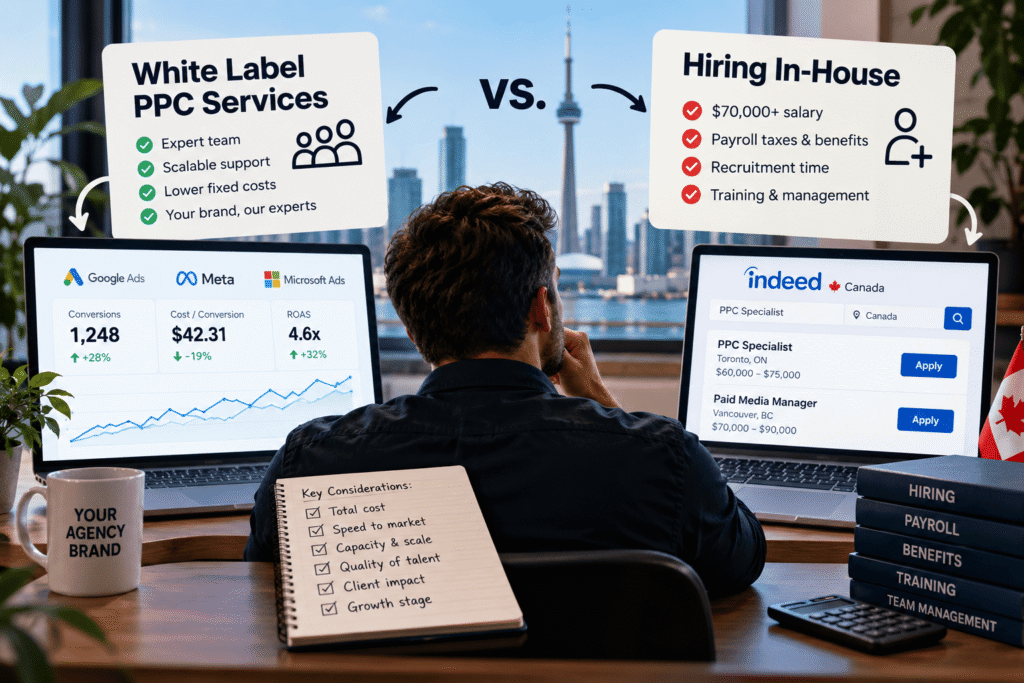
Then you open two tabs side by side on your desktop: Indeed Canada and a white-label PPC provider. You stare at both, weighing a $70,000 full-time salary against a monthly service retainer.
If you run a 5-to-25-person digital agency, SEO shop, or web design studio in Canada, you have probably experienced this.
Deciding how to fulfill paid ad management is one of the highest-stakes choices you will make this year. Get it right, and you add high-margin recurring revenue while deepening client retention. Get it wrong, and you burn through cash, overload your team, or destroy client relationships with poorly optimized campaigns.
This guide provides you with a decision framework built on real Canadian numbers. We will compare salary expectations, statutory payroll burdens (CPP, EI, provincial levies), currency exposures, and operational risks.
The goal isn't to tell you that white label is always better, because it's not in every case. The goal is to give you the financial and operational benchmarks to pick the right path for your agency at your current growth stage. Let's get into it.

Two Models, One Goal
Before running the numbers, let's establish a clear baseline. Both models (white label ppc services vs. an in-house team) exist to solve the same problem: delivering scalable, high-ROI paid ad management across Google Ads, Meta, Microsoft Ads, and vertical networks.
- White Label PPC: An external, specialized media-buying team manages your client accounts under your agency’s brand. Your logo is on every client report. The provider stays completely invisible. Your agency owns the client relationship, account access, and pricing markup; the white label team executes campaign setup, optimization, conversion tracking, and technical strategy.
- Hiring In-House: You recruit a PPC Specialist or Paid Media Manager as a direct employee (T4) on payroll. They work directly inside your communication channels (Slack, Teams), take full ownership of campaign management, and may join client calls as a direct representative of your firm.
Both models can drive impressive client outcomes. But both can fail if mismanaged.
The difference boils down to cost structure (variable vs. fixed), liability, and where your agency sits on its growth curve.
What It Actually Costs to Hire a PPC Specialist in Canada
When Canadian agency owners calculate the cost of a new hire, they almost always start and stop with the base salary figure listed on job postings. That calculation leaves out substantial compulsory overhead.
To understand the real financial commitment of an in-house hire, you must analyze the fully loaded cost of employment in Canada.
1. Base Salary Ranges Across Canada (2026 Data)
Media-buying compensation varies widely depending on experience and location. Verified compensation data across Canadian markets reflects the following base salary bands:
- Entry-Level PPC Specialist (1–3 years experience): $49,000 – $58,000 CAD
- Mid-Level PPC Specialist (3–6 years experience): $58,000 – $70,000 CAD
- Senior PPC Manager / Head of Paid Media (6+ years experience): $70,000 – $90,000+ CAD
Market Adjustment Note: If your agency is based in or hiring out of major metropolitan hubs like Toronto or Vancouver, expect a 10% to 15% salary premium over national averages to compete for top-tier talent. Mid-level specialists in the GTA regularly command $72,000 to $78,000 CAD in base salary alone.
2. The Employer Burden: Compulsory Canadian Payroll Add-Ons
The base salary is simply the baseline. Every T4 hire in Canada incurs mandatory statutory deductions and benefit overhead that your agency must cover out-of-pocket:
- Canada Pension Plan (CPP / CPP2): Employers must match employee CPP contributions dollar-for-dollar up to the Year's Maximum Pensionable Earnings (YMPE). The baseline employer CPP cap reaches $3,867 CAD per employee. High earners falling under the extended CPP2 framework add up to $188 CAD in additional employer matching.
- Employment Insurance (EI): Canadian employers pay 1.4 times the employee EI rate ($2.28 per $100 of insurable earnings). At maximum insurable earnings of ($68,900), the mandatory employer EI contribution reaches ~$1,572 CAD per year.
- Vacation Pay Obligations: Provincial employment standards mandate a minimum of 4% gross vacation pay from Day 1 (which escalates to 6% in most provinces after 5 continuous years of employment). On a $65,000 salary, this equals $2,600 CAD.
- Group Health Benefits: To attract experienced PPC talent away from enterprise corporations, Canadian agencies must offer single or family health/dental/vision coverage. A baseline group plan averages $3,500 to $6,000 CAD annually per employee.
- Employer Health Taxes (EHT / Provincial Levies): Depending on your province, direct payroll taxes apply. Ontario agencies with payrolls over $1M pay a 1.95% EHT. British Columbia, Manitoba, and Newfoundland impose similar health and education levies on business payrolls.
| Cost Line Item | Base Calculation Basis | Approx. Annual Cost (CAD) |
| Base Salary (Mid-Level Specialist) | Market Average | $65,000 |
| CPP Employer Contribution | 2026 Statutory Max | $3,867 |
| EI Employer Contribution | 1.4x Standard Rate | $1,572 |
| Vacation Pay Reserve | Statutory Minimum (4%) | $2,600 |
| Group Health & Dental Benefits | Mid-Tier Coverage | $4,500 |
| Required PPC Software Stack | Pro Software Licenses | $4,800 |
| FULLY LOADED ANNUAL COST | Real Out-of-Pocket Expense | $82,339 – $88,000 |
Note: A mid-level specialist requesting a $65,000 salary can actually cost your agency $82,000 to $88,000 CAD per year before accounting for desk space, hardware, management time, or campaign budgets.
3. Hidden Costs That Don't Appear in Job Postings
Beyond statutory payroll liabilities, hiring an in-house PPC team introduces four unpredictable, non-payroll expenses:
Recruitment & Hiring Costs
Posting roles on LinkedIn Recruiter and Indeed runs $500 to $2,000 CAD per job opening. If you engage a specialized Canadian digital marketing recruitment firm, agency placement fees range from 15% to 20% of first-year base salary, adding an upfront $9,750 to $13,000 CAD cash outlay before the candidate completes Day 1.
The Onboarding & Capacity Ramp
A senior hire does not hit 100% billable efficiency on day one. A typical media buyer requires 3 to 6 months to learn your agency’s client base, workflow systems, communication tools, and vertical nuances. During this onboarding window, they operate at 50% to 70% functional capacity. You are funding 100% of a fully loaded salary while receiving partial billable output.
Pro Tool & Software Infrastructure
A dedicated PPC buyer requires an enterprise software stack:
- Keyword & Competitive Intelligence (Semrush, SpyFu, Ahrefs): ~150–300 CAD/mo
- Reporting & Dashboard Platforms (AgencyAnalytics, Looker Studio Connectors): ~100–200 CAD/mo
- Tracking, Attribution, & Click Fraud Software (ClickCease, Triple Whale): ~100–250 CAD/mo
A complete single-user PPC stack costs $350 to 500+CADpermonth (4,200–$6,000/year).
Industry Turnover & Single-Point-of-Failure Risk
The agency industry faces an average annual staff turnover rate of 18%. If your sole PPC manager resigns, you face an immediate operational crisis:
- Client campaign management drops to zero or shifts back onto the agency owner.
- Client churn rises due to missed optimization cycles.
- You restart the 90-day recruitment, hiring, and onboarding cycle at full cost.
Relying on one person creates a single point of failure. When that employee takes sick leave, requests vacation, or resigns, every paid media account in your agency is exposed simultaneously.
What White Label PPC Actually Costs and What You Keep
White label PPC transforms paid media fulfillment from a high fixed overhead into a flexible, variable expense that scales precisely alongside your client revenue.
1. Typical White Label Agency Pricing Models
White label providers generally price their services on a monthly fee per account, often tied to ad spend tiers. While many global providers charge in USD, North American and Canadian-focused partners operate with clear fee structures:
- Small Accounts ($2,000 – $5,000/mo ad spend): $400 – $800 USD provider fee (~$ 550 – $1,100 CAD)
- Mid-Tier Accounts ($10,000 – $25,000/mo ad spend): $1,200 – $2,500 USD provider fee (~$1,650 – $3,400 CAD)
- Enterprise Accounts ($50,000+/mo ad spend): Custom flat-fee or percentage-of-spend models (typically 6%–10% of ad spend).
2. Agency Pricing Strategy & Gross Margins
To build profitable white-label service offerings, most agencies apply a 2x to 3x markup over provider costs or bundle PPC management into broader monthly retainers.
Unit Economics Per Account
- Client Retainer: You bill the client $1,600 CAD/month for management.
- Provider Cost: You pay your white-label partner $800 CAD/month.
- Gross Margin: You capture $800 CAD/month (50% gross margin).
- Internal Agency Time Invested: ~2 to 4 hours per month reviewing performance metrics, joining client check-ins, and aligning campaign goals.
Scalability Comparison
If your agency scales to 15 active PPC clients using white-label fulfillment:
15 Client Accounts x $800 Net Margin per month = $12,000 CAD per month Gross Profit
That represents $144,000 CAD per year in predictable gross profit, managed with approximately 30 to 45 hours of internal account oversight per month with zero payroll overhead, zero employee liabilities, and zero software licensing costs.
3. The Honest Accounting: What White Label Doesn't Include
To make an objective comparison, you must account for the operational realities of the white label model:
- Client-Facing Account Management: White label providers execute the technical strategy inside ad accounts, but your internal team remains responsible for client communication, monthly strategy calls, and relationship management. Factor in 2 to 4 hours of internal account manager time per account each month.
- Foreign Exchange (FX) Exposure: Many white label providers invoice in USD. If your agency bills Canadian clients in CAD while paying vendor bills in USD, currency fluctuations can erode your margins if you do not build an exchange buffer into your client pricing.
- Account Onboarding Fees: Most specialized white label agencies charge an upfront account setup fee ($150 to $500 CAD per account) to audit historical performance, install conversion tracking (GTM, GA4), and build strategy roadmaps.
- Provider Selection Risk: Selecting an underperforming white label partner can jeopardize client retention. Partnering with low-cost, unvetted offshore providers often leads to poor campaign performance, communication gaps, and damaged agency credibility.
White Label PPC vs. In-House: The Honest Comparison
This side-by-side evaluation outlines the core operational differences between both delivery models:
| Comparison Factor | White Label PPC Partner | Full-Time In-House Hire |
| Upfront Financial Outlay | Low: Minimal setup or onboarding costs per account | High: 10,000–20,000+ CAD (recruitment, onboarding, ramp time) |
| Monthly Cost Structure | Variable: 550–3,400 CAD per active account | Fixed Overhead: 6,800–7,500+ CAD/mo fully loaded payroll |
| Time to Market | Immediate: Accounts operational within 3–5 business days | Slow: 3–6 months for job posting, interviews, hiring, and ramp |
| Depth of Platform Expertise | Broad: Instant access to dedicated Google, Meta, & Analytics teams | Narrow: Dependent on a single buyer's specific skill stack |
| Capacity Scalability | Instant: Onboard 1 or 10 accounts without staffing delays | Constrained: One specialist hits maximum capacity at 8–12 accounts |
| Turnover & HR Liability | Zero: Partner absorbs all hiring, benefit, and turnover costs | High: 18% average industry turnover; single-point-of-failure risk |
| Account Ownership & IP | 100% Agency Owned: Accounts remain fully in your control | 100% Agency Owned: Accounts stay inside agency infrastructure |
| Strategic & Daily Control | Medium: You set strategic direction; partner executes | High: Direct, real-time daily oversight in your office/Slack |
| Ideal Operational Scale | 1 to 15 Active PPC Clients | 15 to 20+ High-Retainer PPC Clients |
Note: This matrix serves as a strategic benchmark. Every agency's exact breaking point varies based on average client retainers, pricing margins, and existing account management capacity.
When In-House Becomes the Right Call
White-label outsourcing is not a permanent destination for every agency. As your agency matures, there is a clear operational tipping point where bringing media buying in-house makes economic and strategic sense.
Here are the three business signals that indicate your agency is ready to hire:
Signal 1: Account Volume Threshold (15–20 Active Clients)
The math shifts when you consistently manage 15 to 20 active PPC accounts. At 18 accounts with an average vendor cost of $800 CAD/month, your monthly white label fulfillment expense reaches $14,400 CAD/month (172,800 CAD/year).
At this spend level, that outlay comfortably covers the $85,000 CAD fully loaded cost of a senior in-house PPC manager, while leaving margin to cover a junior support buyer or advanced software tools. Below 12–15 accounts, the fixed overhead of a full-time hire eats up your agency's net profit.
Signal 2: Paid Ads Is Your Core Differentiator
If your agency's primary value proposition is proprietary, hyper-specialized ad strategies for example, if you market your firm specifically as a niche performance marketing agency for enterprise SaaS, outsourcing your core offering can limit customization. When your brand positioning relies on proprietary media-buying frameworks, owning that IP in-house becomes a strategic priority.
Signal 3: PPC Revenue Exceeds 35–40% of Total Business
If paid search and paid social represent 10% to 15% of your total revenue (a common scenario for SEO firms, web design shops, and PR agencies), an in-house hire introduces disproportionate payroll risk. If you lose two major ad accounts, you are still responsible for 100% of that salary.
Once paid ads comfortably represent over 35% to 40% of your agency’s recurring revenue, your client baseline is stable enough to absorb payroll liabilities.
The Hybrid Growth Framework
Growing agencies rarely leap straight from 100% outsourced to 100% in-house. The most resilient Canadian agencies use a 3-Phase Hybrid Framework:
- Phase 1 (1–10 Accounts): Pure white-label partnership. Focus 100% of internal effort on sales, client relationships, and core services (SEO, design, strategy).
- Phase 2 (10–20 Accounts): Hire an internal Paid Media Account Manager/Director. This individual oversees strategy, leads client communication, and manages the white-label partner, who continues to handle technical execution, buildouts, and campaign monitoring.
- Phase 3 (20+ Accounts): Bring high-volume, flagship accounts in-house under your Paid Media Director. Continue using white-label fulfillment for specialized ad networks (TikTok, Amazon, Programmatic), client overflow, or niche business verticals.
What’s Different About This Decision in Canada
Most online guides comparing agency delivery models rely on US market assumptions. Operating an agency in Canada introduces distinct regulatory, financial, and talent considerations that directly impact this decision.
1. Canadian Statutory Payroll Is Fixed and Mandatory
Unlike US markets where health coverage and retirement contributions vary by state and company size, Canadian statutory burdens are mandatory. Employer CPP, EI, and provincial health taxes apply directly to your payroll. As detailed above, these statutory obligations convert a $65,000 base salary into an $82,000+ real cash outlay.
2. Foreign Exchange (FX) Volatility
The majority of white-label PPC providers invoice their services in US Dollars. Over recent years, the CAD/USD exchange rate has fluctuated significantly (with $1.00 USD costing between $1.34 and $1.42 CAD).
If you charge a Canadian client a fixed retainer of $1,500 CAD/month and pay a vendor $800 USD/month, your fulfillment cost shifts from $1,072 CAD (at 1.34 FX) to $1,136 CAD (at 1.42 FX) based on currency shifts alone.
Actionable FX Strategy: When working with USD-invoiced white label providers, either negotiate CAD-denominated agreements with North American partners or build an explicit 10% to 15% currency cushion into your client-facing service retainers.
3. Quebec Labour & Payroll Regulations
If your agency operates in Quebec, or hires remote staff located in the province, employment costs follow these rules:
- Quebec Pension Plan (QPP): Quebec replaces CPP with QPP, carrying an employer contribution rate of 6.4% (higher than the national 5.95% CPP rate).
- Quebec Parental Insurance Plan (QPIP): Employers must pay QPIP premiums on all insurable employee payroll.
- EI Rates in Quebec: The employer EI contribution rate in Quebec is lower ($1.82 per $100) to offset QPIP contributions.
These regulatory requirements add administrative overhead to managing remote Canadian hires. White label partnerships eliminate these provincial compliance requirements entirely.
4. Regional Marketing Talent Scarcity
The Canadian digital marketing talent market is heavily concentrated in major metro centers. If your agency is based in markets like Calgary, Edmonton, Ottawa, Winnipeg, Halifax, or Victoria, sourcing local, senior-level PPC managers with verified platform certifications is challenging.
While Toronto and Vancouver offer larger talent pools, local salary expectations reflect the high cost of living in those cities. Partnering with a white-label provider gives regional agencies immediate access to senior media-buying talent without requiring relocation packages or enterprise-level metro compensation.
5. PIPEDA, Bill C-27, and Canadian Data Sovereignty
If your agency serves clients in regulated Canadian industries, such as financial services, legal, healthcare, or public sector, how you handle consumer data is governed by PIPEDA and the modernized Consumer Privacy Protection Act (Bill C-27).
When vetting US-based or international white label providers, verify how campaign tracking, customer match lists, and first-party data are stored and transmitted. Working with partners that adhere to strict North American data privacy standards ensures your agency remains fully compliant.
How to Choose: A Decision Framework for Canadian Agency Owners
Use this decision matrix to evaluate your agency's current position and select the appropriate fulfillment path:
Start with White Label PPC if:
- You currently manage fewer than 12 active PPC accounts.
- Paid ads represent less than 30% of your total monthly recurring revenue.
- Your core agency services are SEO, web development, branding, or PR, and clients are asking you to add paid media.
- You operate outside major metro areas and face local PPC talent shortages.
- You want to offer multi-platform expertise (Google Ads, Meta, Microsoft, YouTube) without hiring multiple specialists.
- You prefer to keep fixed payroll costs low while building agency cash reserves.
Start Building Toward In-House Hiring if:
- You consistently manage over 15 to 20 active PPC accounts.
- Paid media accounts for over 35% to 40% of your agency's gross revenue.
- Your core brand positioning is built on proprietary media-buying strategies and custom ad frameworks.
- You have existing internal management capacity to recruit, train, and oversee technical media buyers.
- Your enterprise clients mandate dedicated, named in-house specialists on their weekly status calls.
Adopt the Hybrid Model if:
- You manage 10 to 18 PPC clients and are preparing for your next growth phase.
- You want to bring high-touch client strategy in-house while outsourcing campaign builds, tracking, and daily execution.
- You manage 1–2 large flagship enterprise accounts alongside 8–10 small-to-medium SMB accounts.
Why You Should Outsource Your PPC to a White Label PPC Agency.
Before You Post That Job Listing: 5 Questions to Answer
Before posting a job ad on Indeed or signing a vendor contract, sit down with your agency leadership team and review these five questions:
1. How many PPC clients can our sales pipeline realistically close in the next 90 days?
If your pipeline shows 2 to 4 potential ad management clients, adding an $83,000+ CAD annual payroll obligation poses a significant financial risk. White label allows you to onboard those clients profitably from Day 1 without committing to fixed salary overhead.
2. What happens to our agency operations if an in-house hire leaves after 12 months?
Consider the impact on your business: Who steps in to manage client campaigns during the 60-day recruitment window? How much revenue would be at risk if client performance drops during the transition? If single-employee turnover threatens your client retention, build a multi-layered fulfillment model first.
3. Have we built a foreign exchange buffer into our client pricing model?
If you partner with a white-label vendor that invoices in USD, protect your gross margins by setting your CAD client retainers with a 10% to 15% currency buffer, or choose a partner with a transparent, CAD-aligned pricing structure.
4. Do we have an objective process to vet white-label providers?
White label fulfillment is an extension of your agency's reputation. Do not choose partners based on rock-bottom pricing alone. Evaluate their case studies, proof of performance, Google Partner status, reporting dashboards, and communication SLAs before handing over client accounts.
5. Is our agency's core strength delivery execution or client relationships?
If your clients stay with your agency primarily because of your high-touch communication, strategic direction, and business relationships, white label execution allows you to double down on those strengths. You handle account management and growth strategy, while your white label partner manages campaign builds and optimization.
The Right Answer Fits Your Agency Right Now
The debate between white label PPC and an in-house team is not about determining which model is universally superior. It is about identifying which model aligns with your current client account volume, cash flow, and operational capacity.
For the vast majority of Canadian digital agencies managing under 15 active PPC accounts, white-label PPC services are the most financially sound, operationally flexible, and risk-managed choice. It protects your cash flow, eliminates statutory Canadian payroll burdens, and gives you instant access to specialized media-buying teams.
As your account volume grows past 15 to 20 clients, bringing media buying in-house or transitioning to a hybrid model becomes a logical next step.
Base your decision on real metrics: calculate your fully loaded employment costs, review your active account numbers, and select the model that protects your profit margins today while positioning your agency for sustainable growth.
Grow Your Canadian Agency with a Trusted White Label PPC Services Partner
Evaluating white-label PPC fulfillment for your agency?
Ninja PPC works alongside Canadian and North American digital agencies, providing ppc ads, white-label Google Ads, Meta Ads, and multi-channel performance marketing.
We handle campaign builds, ongoing optimization, and technical tracking under your brand so you can scale your agency margin without expanding payroll. We're here to give you the ppc solutions, so you can focus on what you do best.
Book a White Label Strategy Consultation with Ninja PPC Today


How White-Label PPC Agencies Help Marketing Agencies Scale Faster
How White-Label PPC Agencies Help Marketing Agencies Scale Faster
Growth sounds great until your agency starts hitting capacity.
At first, adding new clients feels exciting, but then the workload builds up, your team becomes overwhelmed, deadlines become tighter, and clients start asking for PPC services, but you don't have the staff or experience to deliver them at a high level.
This is where a white-label PPC agency enters the scene as a growth partner. Instead of hiring, training, and managing an in-house PPC team, you can partner with specialists who handle campaign management behind the scenes while your agency remains the client-facing brand.
The result is faster growth and the ability to serve more clients without overwhelming your team, while still increasing revenue.

Why Scaling PPC Services Is Challenging
You may be great at SEO, web design, content marketing, or social media management. Then a client asks if you also manage Google Ads. If the answer is no, you risk losing revenue or sending that client elsewhere.
Many agencies reach this point where demand outpaces capacity. Building an in-house PPC department sounds like the obvious solution, but in reality, it often creates new challenges.
You need to:
- Recruit experienced PPC specialists
- Pay salaries and benefits
- Invest in training
- Purchase reporting and management tools
- Create internal processes
- Manage quality control
Even after making those investments, there is no guarantee you will have enough PPC clients to keep a full-time team busy. This creates unnecessary risk, especially for growing agencies.
How a White-Label PPC Agency Helps You Grow
A white-label PPC agency acts as an extension of your team. Your clients work with your agency while the PPC partner manages campaign strategy, setup, optimization, and reporting behind the scenes, allowing you to scale based on demand.
Whether you add one or ten new PPC clients, you don't need to hire additional staff or reorganize your team. You simply expand your service offering while your white-label partner handles the fulfillment.
Increase Revenue Without Increasing Overhead
One of the biggest challenges agencies face is balancing growth with profitability, because adding more clients often means adding more employees. More employees mean higher payroll expenses and more management responsibilities.
A white-label PPC agency changes that equation. Instead of investing in new hires, you gain access to an experienced PPC team that already has the necessary knowledge and tools to do the job efficiently. This allows you to:
- Create new recurring revenue streams
- Expand your service packages
- Increase client retention
- Improve profit margins
- Reduce operational costs
Many agencies discover that existing clients are happy to add PPC services when offered by a trusted partner. Rather than finding new customers, you can increase revenue from your current client base.
Common Agency Growth Challenges and Solutions
Clients Need More Services
Opportunity: A client wants SEO, website design, and Google Ads from a single provider.
Challenge: Without PPC expertise, you either decline the work or refer it elsewhere.
Solution: With a white-label PPC agency, you can offer a complete solution without hiring internally.
Your Team Is Already Busy
Opportunity: Your account managers and specialists are working at capacity.
Challenge: Adding PPC management creates more pressure and increases the risk of burnout.
Solution: Outsourced fulfillment allows your team to focus on client relationships and business development while PPC specialists handle campaign execution.
Hiring Takes Too Long
Opportunity: Finding experienced PPC professionals is difficult and expensive.
Challenge: Even after hiring, onboarding and training take time.
Solution: A white-label partner gives you immediate access to experienced PPC experts without the delays of recruitment.
In-House PPC vs Freelancers vs White-Label PPC Agencies
Not every agency chooses the same path. Here's how the most common options compare.
| Factor | In-House PPC Team | Freelancer | White-Label PPC Agency |
| Upfront Cost | High | Low | Low to moderate |
| Hiring Required | Yes | No | No |
| Scalability | Limited by team size | Limited by availability | High |
| Access to Multiple Experts | Usually No | Usually No | Yes |
| Reporting Systems | Must build internally | Varies | Usually included |
| Coverage During Vacations or Sick Days | Limited | Limited | Consistent |
| Ability to Handle Growth | Slower | Unpredictable | Fast |
| Management Time Required | High | Moderate | Low |
| Long-Term Stability | High if fully staffed | Varies | High |
Freelancers can work well for individual projects. However, from time to time, agencies run into capacity issues as client numbers grow.
A white-label PPC agency provides the flexibility of outsourcing with the consistency and support of a dedicated team.
Access Expertise Without Building It Yourself
PPC platforms change constantly. New campaign types, bidding strategies, audience targeting options, and platform updates require ongoing attention. When PPC is not your agency's primary focus, keeping up with these changes becomes difficult.
A white-label PPC agency lives in this world every day. Instead of spending months developing internal expertise, you gain access to specialists who already understand the latest best practices and industry changes.
This reduces risk and helps deliver stronger results for your clients.
Focus on Growth Instead of Fulfillment
Client meetings, reporting, campaign management, hiring, training, and quality control consume valuable time. By outsourcing PPC campaigns, you free up resources to focus on activities that drive growth.
That includes:
- Closing new clients
- Building partnerships
- Improving client relationships
- Expanding service offerings
- Increasing recurring revenue
The result of using a white-label PPC agency is simple: you can offer more services, retain more clients, increase recurring revenue, and grow faster without increasing your internal workload.
For agencies looking to expand without taking on the cost and challenges of building an in-house team, white-label PPC agencies like PPC Ninja provide a proven path to sustainable growth. Contact us today for more information.

How to Offer PPC Services Without Hiring New Staff
How to Offer PPC Services Without Hiring New Staff
Many agencies reach the same point where clients ask for Google Ads management, prospects want PPC (Pay-Per-Click ads) included in their service package, or existing customers prefer working with one agency instead of multiple providers depending on the service they need.
When that happens, there’s a clear opportunity. However, there’s also a challenge: how to deliver PPC services without overwhelming your team. In this situation, hiring an in-house PPC department sounds like a solution, but in reality, it often creates new problems as recruitment takes time, training requires resources, your payroll increases, and managing another team adds complexity.
The good news is that you don’t need to hire new employees to offer PPC management. With white-label PPC services, you can expand your agency’s service offerings and keep client relationships under your own brand.

Why Agencies Struggle to Add PPC Services
Most agency owners understand the value of PPC. The issue is execution.
You need clear processes, reporting systems, quality control, account management, and ongoing training. Building a PPC team requires more than finding one skilled specialist and the investment creates several barriers.
Hiring Costs Add Up Quickly
Experienced PPC professionals aren’t easy to find or cheap to hire. Beyond salary, there are additional costs for recruitment, benefits, software, management time, and ongoing training. For many agencies, these expenses arrive before enough PPC revenue exists to support them.
Onboarding Takes Time
Even a great hire needs time to learn your processes, reporting expectations, communication style, the specific tools used by the agency on a daily basis, and client portfolio. While that happens, opportunities continue to pass by.
Knowledge Gaps Create Risk
The online advertising landscape changes constantly as campaign types, bidding strategies, targeting options, and platform features continue to evolve. Agencies without dedicated PPC experience often struggle to stay current, which can hurt client trust.
Capacity Limits Slow Growth
Many agencies already operate with lean teams, so adding PPC management to an already busy workload often leads to missed deadlines, slower communication, and lower service quality.
Growth becomes difficult when your team is already at capacity.
How White-Label PPC Services Solve These Problems
You can offer PPC management services without building out your own team. A white-label PPC team takes over management behind the scenes, including campaign setup, campaign management, campaign optimization, reporting, and strategy.
From the client's perspective, it looks like your agency is offering the service to them. This approach removes many of the major challenges that prevent agencies from scaling.
To summarise how white-label PPC works: Rather than hiring specialists, you gain access to experienced professionals immediately while also avoiding adding costs to the operation. Rather than building a team and processes over months, you use systems that are already in place.
Keep Your Brand Front and Centre
A fear many agencies have regarding outsourcing is losing control of the relationship with the client.
That doesn’t happen when you work with white-label partners because your clients continue working with your agency, so you control the communication and reports carry your branding while the fulfillment partner works in the background.
The best part? The service is provided in a way that allows your business to leverage client loyalty and grow the services offered to existing customers.
Create New Revenue Streams Faster
Many agencies already have clients who need PPC services. They simply haven’t been offered to them yet. Adding PPC creates opportunities to increase monthly recurring revenue without finding new customers.
A client who already trusts your agency is often more likely to purchase additional services from you than searching for another provider, which creates organic growth opportunities within your existing client base.
Comparing Your Options
When agencies decide to add PPC services, they generally choose one of three approaches.
| Comparison Area | In-House Hire | Freelancer | White-Label PPC Services |
| Time to Get Started | Slow | Moderate | Fast |
| Cost Level | High | Low to Moderate | Moderate |
| Flexibility to Scale Up/Down | Limited | Limited | High |
| Depth of Expertise | Single Skillset | Varies | Team-Based Expertise |
| Process & Workflow Setup | Build Internally | Inconsistent | Pre-Established |
| Oversight Required | High | Moderate | Low |
| Consistency of Delivery | Moderate | Can be inconsistent | High |
| Support for Agency Growth | Limited | Short-Term | Long-Term |
Freelancers can help with short-term projects. However, availability often becomes a challenge as client demand increases.
On the other hand, white-label PPC services provide the flexibility of outsourcing while offering the structure and reliability agencies need to grow.
A Simple Process for Launching PPC Services Quickly
You don’t need to spend months building a PPC division. Many agencies follow a straightforward process:
1. Identify Client Demand
Start by reviewing your current client base, looking for businesses already investing in digital marketing that would benefit from Pay-Per-Click management.
2. Choose a White-Label PPC Partner
Look for a provider with experience managing campaigns across multiple industries that offers expertise, transparent reporting, clear communication, and scalable support.
3. Define Your Service Packages
Decide how PPC fits into your existing offerings and keep pricing simple and easy to explain. Some agencies offer standalone PPC management. Others bundle it with SEO, website design, or social media marketing.
4. Create a Client Onboarding Process
Develop a consistent process for gathering business information, goals, budgets, and account access for a smooth onboarding experience that builds confidence from the start.
5. Launch and Scale
Begin with a few accounts and, as confidence grows, expand your PPC offering across your client base and sales pipeline. Because fulfillment is already handled, scaling becomes much easier.
Shift Your Time Toward Scaling the Business
Agency owners often spend too much time solving operational problems such as hiring, training, people and resource management, process development, and more. These tasks are all a vital part of the business, but they aren’t bringing in any revenue.
White-label PPC services allow you to spend more time growing your agency and less time managing delivery, so your team can focus on:
- Client relationships
- Business development
- Sales
- Strategy
- Account growth
Meanwhile, the PPC specialists do all the campaign work.
That creates a more efficient business model and removes many of the barriers that slow agency growth.
Ready to Scale Your PPC Services?
Expanding into PPC doesn’t have to follow the traditional path of building an in-house team from scratch. Many agencies are finding that a more flexible approach works better.
White-label PPC services give you the ability to move quickly, adapt to client needs, and deliver consistent results without disrupting your current operations.
Rather than treating PPC as a major internal expansion, you can introduce it as a scalable service that evolves alongside your agency. This approach reduces risk and allows you to focus on what matters most: building strong client relationships and driving measurable growth.
Contact us today for more information.

Questions Every Agency Should Ask Before Choosing a White Label PPC Partner
Questions Every Agency Should Ask Before Choosing a White Label PPC Partner
Choosing a white label PPC provider isn’t the same as hiring a vendor. You are trusting another company to help deliver results under your brand, and their work affects your client retention, reputation, and revenue. If they perform well, your agency looks good. If they make mistakes, your agency is the one that will be held responsible. That’s why choosing the right partner deserves careful attention.
Many agencies focus on pricing first, while others get distracted by promises of fast results. The smarter approach is asking the right questions before signing an agreement.
Here's what to evaluate before committing to a white label PPC management partner.

Why Choosing the Right Partner Matters
A white label PPC partner can become a long-term part of your business, depending on your goals and approach. This partner may manage dozens of your client accounts and influence client retention rates.
If you decide to switch providers later because you’re not happy with the results, it can be disruptive as campaign transitions take time, and clients may notice service interruptions. The more thoroughly you evaluate a provider upfront, the fewer problems you face later.
Question to Ask a White Label PPC Provider
Is Reporting Transparent and Easy to Understand?
Reporting is often the first thing clients see. If reports are confusing, incomplete, or difficult to read and explain, your agency ends up answering unnecessary questions and defending data that isn't clear.
Ask potential partners:
- What reports are included?
- How often are reports delivered?
- Are reports white-labelled?
- Can reports be customized?
- Will we have access to live campaign data?
A strong provider makes reporting simple, accurate, and transparent. If it feels unclear, it rarely improves after onboarding.
Who Owns the Advertising Accounts?
Some agencies discover too late that they don’t control important account assets.
Before moving forward, make sure to ask:
- Who owns the advertising account?
- Who owns conversion tracking setups?
- Who maintains access permissions?
- What happens if the partnership ends?
You should always understand exactly who controls the assets connected to your clients to avoid disputes and make future transitions easier.
What Does Communication Look Like?
Even great campaign performance can be overshadowed by poor communication. Response times matter. Accessibility matters. Problem-solving matters.
Ask questions such as:
- Who will be our primary contact?
- How quickly are emails answered?
- Are meetings available when needed?
- How are urgent issues handled?
- How are campaign updates communicated?
The best partnerships operate like an extension of your team rather than a disconnected third party.
What Experience Does the Team Have?
Experience goes beyond the number of years in business. You want to understand who is actually managing accounts.
Ask:
- Who manages campaigns day to day?
- What industries have you worked with?
- Do specialists manage specific account types?
- How do you stay current with platform changes?
A provider with broad experience is better equipped to handle different client goals, budgets, industries, and opportunities.
How Are Campaigns Structured?
Campaign structure affects performance and long-term scalability. Some providers rely heavily on templates. Others build customized account structures based on client goals.
Ask questions like:
- How do you organize campaigns?
- How do you structure ad groups?
- How is conversion tracking implemented?
- How often are accounts reviewed?
You don’t need advanced technical knowledge to ask these questions. You simply want to understand whether there’s a clear process behind the work.
What Does the Onboarding Process Include?
Poor onboarding creates confusion, delays, and missed expectations. It also reflects how organized a provider is (or isn't).
Ask potential partners:
- What information is required to start?
- How long does onboarding take?
- Who gathers account access?
- How are client goals documented?
- What happens during the first month?
A structured onboarding process creates a stronger foundation for campaign success.
How Is Pricing Structured?
Pricing should be easy to understand to avoid frustration later.
Ask:
- Is pricing based on ad spend?
- Are there setup fees?
- Are there minimum commitments?
- Are there additional charges for reporting or meetings?
- How are account changes billed?
The lowest price isn’t always the best value. You should focus on reliable service, communication, expertise, and results instead of simply choosing the cheapest option.
What Turnaround Times Can We Expect?
Clients expect action quickly, so you need realistic expectations for campaign launches, account updates, and support requests.
Important questions include:
- How long does campaign setup take?
- How quickly are optimization requests completed?
- How fast are reports delivered?
- What happens during urgent situations?
How Do You Define Success?
Different providers measure campaign success differently. Some focus on clicks, others focus on conversions, leads, revenue, or return on ad spend.
Ask:
- Which KPIs do you prioritize?
- How are goals established?
- How frequently is performance reviewed?
- How are recommendations presented?
These questions are important because a strong white label PPC management partner should align performance metrics with your clients' business goals.
White Label PPC Partner Evaluation Checklist
Use this checklist when evaluating potential providers:
| Evaluation Area | Key Question |
| Reporting | Are reports transparent and branded? |
| Account Ownership | Who controls the advertising accounts? |
| Communication | How quickly does the team respond? |
| Experience | What industries and campaign types have they managed? |
| Campaign Structure | Is there a documented management process? |
| Onboarding | Is there a clear onboarding system? |
| Pricing | Are all costs clearly explained? |
| Turnaround Time | How quickly are requests completed? |
| Performance Measurement | How is campaign success defined and reported? |
| Long-Term Support | Can the partnership scale with agency growth? |
Common Red Flags to Watch For
Pay attention to the following warning signs during the evaluation process.
Guaranteed Results
No PPC provider can guarantee specific lead volumes, conversion rates, revenue outcomes, or ROI. Overpromising is often a sign of unrealistic expectations.
Vague Answers
If simple questions receive unclear responses, expect communication challenges later. Transparency should exist from the beginning.
Limited Reporting Access
You should never feel disconnected from campaign performance. Providers that restrict access to data create unnecessary risk.
No Defined Process
Strong agencies operate with systems and procedures. If a provider can’t explain their workflow clearly, consistency becomes a challenge.
Pricing That Seems Too Good
Extremely low pricing often means corners are being cut somewhere. That may appear in campaign management quality, support levels, reporting, or account oversight.
Focus on Partnership, Not Just Fulfillment
The strongest partners look beyond campaign management. When evaluating providers, look beyond deliverables and pricing, and ask yourself whether the company feels like a long-term partner.
The right white label PPC management provider helps you provide your clients with better experiences, maintain confidence in your service offering, and build a stronger agency that can continue growing.
Choosing carefully today saves countless problems tomorrow. Contact PPC Ninja to learn how our white label PPC management services help agencies deliver consistent results while maintaining full client ownership.

When Should a Marketing Agency Outsource PPC Management?
When Should a Marketing Agency Outsource PPC Management?
Many agencies don’t decide to outsource PPC management because they want to. They do it because they reach a point where their current approach is no longer working.
A growing client list, inconsistent campaign results, overloaded teams, and difficulty finding experienced PPC talent all create pressure. The challenge is recognizing the signs early enough to make a smart decision because, if you wait too long, team stress increases and growth opportunities start slipping away.
Continue reading to discover when white label PPC management becomes worth considering.
Why Agencies Delay Outsourcing
Some agency owners take pride in keeping work in-house because there’s a sense of control that comes from managing everything internally. You know the team, the processes, and exactly what’s happening inside each account. The problem is that growth changes the equation.
As client demands increase, maintaining the same level of service becomes more difficult. Eventually, agency owners find themselves spending more time managing PPC operations than growing the business.
By the time many agencies consider outsourcing, the warning signs have already been present for months.
Sign #1: Your Team Lacks Dedicated PPC Expertise
PPC has become increasingly specialized. Managing campaigns effectively requires ongoing education, platform knowledge, conversion tracking expertise, and constant optimization.
Many agencies offer PPC as an additional service without having a true PPC specialist on staff. At first, this can work. Over time, however, gaps in knowledge become more visible. Campaigns start to underperform, opportunities are missed, and clients begin asking more advanced questions.
If PPC isn’t one of your agency's core strengths, outsourcing provides immediate access to deeper expertise.
Sign #2: Capacity Is Becoming a Problem
One of the clearest indicators that it's time to outsource PPC management is workload. When account managers, SEO specialists, or social media professionals are handling PPC work on top of their existing responsibilities, something usually gets sacrificed. Deadlines become harder to meet, communication slows down, optimization tasks get delayed, and client service starts to suffer.
Sign #3: Campaign Performance Is Inconsistent
Not every campaign produces identical results. However, there’s a difference between normal performance fluctuations and a pattern of inconsistent management.
If some accounts perform well while others receive limited attention, your process may not be scalable. White label PPC management providers often have established workflows that help create better consistency across accounts.
Sign #4: Hiring PPC Talent Has Become Difficult
Finding experienced PPC professionals takes time, recruiting costs money, training requires resources, and then retention creates another challenge because even after making a hire, there’s no guarantee the professional will stay long-term.
For agencies struggling to fill PPC roles, outsourcing can be a more practical solution than continuing a lengthy and costly hiring process.
Sign #5: You Want to Grow Without Slowing Down
Growth creates new demands. Some agency owners hesitate to pursue new opportunities because they are already operating near capacity. In this case, growth stops not because demand disappears, but because delivery becomes the limiting factor.
A white label PPC third-party provider gives agencies space to scale without constantly rebuilding internal resources.
The Risks of Waiting Too Long
Delaying outsourcing decisions can create problems that are difficult to reverse.
The most common risks include:
- Declining campaign performance
- Missed client opportunities
- Slower response times
- Team burnout
- Lower client retention
- Reduced profitability
Many agencies assume they should outsource only when a crisis occurs. A better approach is making the transition before operational pressure starts affecting service quality.
Real Agency Scenarios
The decision to outsource often becomes easier when viewed through real-world situations. For example:
The Agency Owner Managing Everything
A small agency wins several new clients within a short period, and the owner needs to handle sales, account management, reporting, and PPC strategy personally.
At first, the workload feels manageable, but after several months, campaign reviews are delayed, reporting takes longer, and client communication becomes inconsistent.
Outsourcing allows the owner to focus on growth while specialists manage campaign execution.
The SEO Agency Expanding Services
An SEO-focused agency starts receiving requests for Google Ads management. The team understands digital marketing but lacks advanced PPC experience, but rather than turning away opportunities, the agency partners with a white label provider and expands its service offering without increasing internal complexity.
The Growing Agency Facing Hiring Challenges
A mid-sized agency decides to build an in-house PPC team. Months pass with limited hiring success and, meanwhile, new client opportunities continue arriving, so instead of waiting for the perfect candidate, the agency outsources fulfillment and continues growing while its recruiting efforts can continue.
Agency Readiness Checklist
If you answer "yes" to several of these questions, outsourcing may be worth exploring.
| Question | Yes / No |
| Are PPC requests increasing from existing clients? | |
| Is your team struggling to keep up with campaign workloads? | |
| Do you lack dedicated PPC specialists? | |
| Have campaign performance issues become more common? | |
| Are hiring efforts taking longer than expected? | |
| Is leadership spending too much time managing PPC operations? | |
| Do you want to scale without significantly increasing payroll? | |
| Are you concerned about maintaining service quality as you grow? |
Focus on Growth Before Capacity Becomes a Problem
The best time to evaluate outsourcing isn’t when your agency is overwhelmed. It’s when you begin seeing signs that your current model will struggle to support future growth. By acting early, you can protect service quality, reduce operational pressure, and position your agency for long-term success.
If your team is facing expertise gaps, capacity challenges, hiring difficulties, or growing client demand, a white label PPC partner can provide the support needed to scale confidently while maintaining the standards your clients expect.
Looking for a trusted white label PPC management partner? Contact PPC Ninja to learn how we help agencies expand their PPC capabilities without sacrificing quality, control, or client relationships.